How to Get Climbing News in Your Inbox — Beta With Your Morning Coffee
Published July 3, 2026
You're refreshing the IFSC results page under the desk because the boulder final in Japan ends exactly when your stand-up starts.
Good news—you're in the right place! A daily climbing brief takes about two minutes to set up, and the first edition is free.
In this guide, I'll show you how to get climbing news in your inbox with MorningMail, which I built: an AI agent searches the web fresh every morning and writes you one short email—comps, first ascents, gear, training research.
Chalk up—this is a two-minute problem.
What you'll build

The usual fix is following thirty accounts and hoping the algorithm cooperates. It won't—a viral gym-fail reel will always outrank the trip report you'd have loved.
A personal brief works from your instruction instead. Every morning an AI agent searches the web fresh and writes you an email—not forwarded posts, a few real sentences about what was climbed and why the line matters, primary sources linked.
One great story a day beats thirty follows. And your prompt carries your climbing: boulderer, trad ethicist, board-training nerd—it all fits in a sentence you can edit any evening, and the next morning's brief already climbs differently.
See it live: the latest edition
So here's a real example. This is the edition from August 13, 2026 of exactly this newsletter — written by the agent that morning, based on the example prompt from this guide. Not a mockup: I run it myself on MorningMail.
Edition from August 13, 2026
Garnbret's historic ascent, Emil's comeback, gear breaks under load
Janja's Historic Send
Janja Garnbret just climbed something no one else has.
She sent Bibliographie, a route that sits at the absolute frontier of sport climbing difficulty [Quelle: The Struggle]. Filmmaker Jon Glassberg was there to document what it takes to capture climbing's rarest moments—not just the send itself, but the process, the fails, the mental architecture that makes it possible. That footage matters because ascents at this level are still so rare that every one teaches something about what the human body and mind can do together.
The climbing world watches moments like this to understand its own horizon.
Emil's Return to Hard Climbing
Emil Abrahamsson sent his hardest route after being told to quit.
The Swedish climber appeared on The Struggle to discuss the training breakthroughs that got him back to elite sends following a scare that nearly ended his climbing career [Quelle: The Struggle]. His story sits at the intersection of physiology and psychology—figuring out not just how to train harder, but how to come back from the moment you believe it's over. That kind of comeback carries weight because the path isn't obvious.
His training protocols are already being studied by coaches hunting for the same magic.
Breaking Through the Wall
Elite climbers are cracking the code on training volume.
Nate Drolet and others featured on The Struggle are working through the mechanics of structured training plans and maximum tolerable training doses—the threshold where more reps stop building and start breaking [Quelle: The Struggle]. The pattern emerging across these conversations is deliberate: plateaus aren't walls, they're signals. When progress stalls, the answer isn't always harder—it's smarter placement of hard. Knowing where that line sits separates climbers who push through and climbers who recover.
The athletes who master this calibration will be the ones setting the next generation of records.
 The Struggle Climbing Show23 hours ago ... The best climbers in the world share their struggles and breakthroughs in Training, Nutrition, Tactics, and Mental Game. Hosted by Ryan Devlin.thestruggleclimbingshow.com
One click creates your own editable copy — change the prompt, the delivery time, everything.
Browse all editions →You could get this general version into your inbox right now — and then fine-tune it to your very specific needs. Here's how to do it:
Step by step: from zero to your first edition
The whole setup takes about two minutes. And every screenshot below comes straight from the real product — nothing is mocked up.
Step 1 Open morningmail.ai
No account yet, nothing to install — the landing page IS where you compose. A friendly press robot introduces itself above one big input, and the paper you're about to fill sits waiting on the right.

Step 2 Type your topic: Climbing
Type Climbing into that one input. There is nothing to pick and no form to fill — as you type, a draft section forms on the paper beside you, carrying your topic in a tinted badge and the quiet prompt "↵ Enter adds it".

Step 3 Press Enter — and read what the agent was told
Type Climbing into the one big input on the landing page and press Enter. The section lands carrying three things you didn't have to write: a beat badge, a suggested headline and an Assignment—the exact instruction the agent will carry to work each morning. No account, no picker, no blank field to fill in first.
The philosophy behind it is one great thing a day—a story about craft, results or characters you'd share at the gym between attempts, not a wall of links. It's good as-is, and better sharpened. Click the Assignment to rewrite it, or tap a tweak like "+ name sources" to append a line. Mine says: "favour first ascents and comp finals over gear press releases; for new training research, summarise the method, not just the result."
The exact prompt your section starts withSomething genuinely worth knowing about Climbing today — one development, why it matters and where the detail lives. Substance over volume.
Step 4 Send your free first edition
Happy with the paper? Hit "Send my free first edition". The sign-up appears right there — the paper never leaves the screen — and asks the only thing it still needs: where to send it. Email and password, or Google. No card, and the first edition is free.

Step 5 Watch it being written
Now the desk goes to work in front of you: working out what to look for, searching the web, reading the best sources, writing your section, composing a subject line, handing it to the post. A minute or two later: "It's in your inbox."

Step 6 Afterwards: the time, the days, the readers
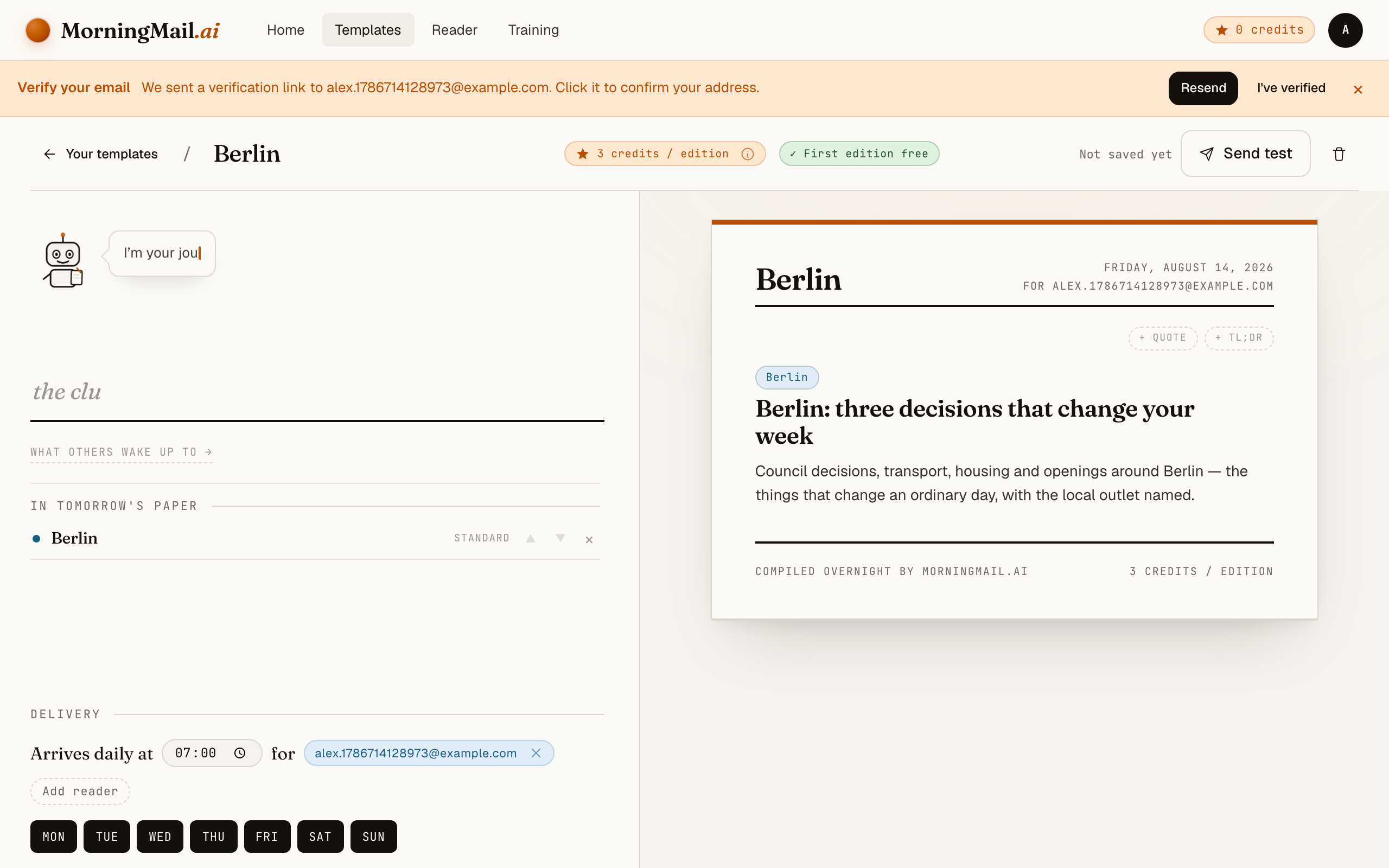
Everything else lives in the builder, once you have a paper to tune. Set the delivery time (07:00 by default) and which weekdays it runs, add readers — up to 100 — and add more topics the same way you added the first: by typing. Nothing here needs deciding on day one.
Get more out of your brief
- Declare your discipline
- Bouldering, sport, trad, alpine—"climbing" is four sports pretending to be one. A clause like "I boulder and follow IFSC bouldering; mention rope events only for finals" keeps the brief on your wall instead of somebody else's.
- Sync the brief with the comp calendar
- World Cup season is dense; the off-season isn't. Add "during IFSC season, lead with results and notable performances" and the brief covers comps in spring, then drifts back to ascents and stories in winter—no prompt surgery needed between.
- Ask for context on big ascents
- A name and a grade is trivia; history is a story. Request "for significant ascents, one sentence on where the route sits historically" and a repeat of a testpiece arrives with the framing that makes it worth retelling.
- Keep access and ethics on the radar
- Crag closures and bolting debates rarely trend, but they decide where you actually climb. One line—"include access or ethics news when it affects climbers in my region"—makes the brief useful beyond entertainment.
- Weekly works too — use the weekday chips
- Every template has a delivery time and selectable weekdays. A Friday brief before a weekend at the crag is a popular pattern; during World Cups, flip the same template back to daily with two taps.
Good sources to anchor your brief on
The agent searches the open web every morning and cites where it read things. These are the sources I'd point it at in your prompt:
- IFSC — The federation itself — World Cup schedules, results, rankings and rule changes for lead, boulder and speed, straight from the primary source.
- Climbing Magazine — Long-form features, ascent reporting, training columns and gear reviews from one of the sport's longest-running English-language publications.
- UKClimbing — News, logbooks and the liveliest forums in the sport — where ascents get verified, graded and argued about, often before anywhere else.
- PlanetMountain — The European reference for alpinism and hard rock — first ascents in the Alps and beyond, interviews and expedition reports with real depth.
- 8a.nu — The ascent database and news site where hard sends are logged and grade consensus forms — the sport's living scoreboard outside competitions.
Frequently asked questions
- What does the climbing brief cost?
- The first edition is free and needs no credit card. After that, each send costs a few credits per section depending on the AI model tier—and credits never expire, so a weekends-only cadence never wastes them.
- Isn't Instagram enough for climbing news?
- Instagram is where climbing news performs, not where it's organised. You get what the algorithm rates, minus what it buried. A written brief answers your standing instruction instead: searched fresh each morning, one story chosen for you, sources linked—zero reels to swim through.
- Can it cover both competitions and outdoor ascents?
- Yes—and you set the balance. The prompt is fully editable, so "comps first during IFSC season, otherwise first ascents and notable repeats" is a perfectly normal instruction the agent re-reads every single morning.
- Will it report training research accurately?
- The agent links its primary sources, so every claim comes with the paper or article behind it. Ask it to "summarise the method and sample size, not just the headline finding"—a good habit for any research-heavy brief.
- Can my climbing partners get the same email?
- Yes—a template can have multiple recipients, so the whole rope team wakes up to the same brief. You can also share a section to the public community gallery for climbers you've never met.
Your inbox, your editor
Build your own AI-written brief in two minutes. The first edition is on me — no credit card required.
Build your brief — freeI am always happy to answer questions and I'm open to feedback. Feel free to reach out at any time: marius@morningmail.ai