How to Stay Updated on Legal Tech as a Lawyer — One Short Email Every Morning
Published July 3, 2026
"Are we using anything like this?" Your partner slides her phone across the table — an AI contract-review tool you've never heard of, and a client asking about it tomorrow.
Good news — you're in the right place! You don't need another subscription to fix this, just one short email. Setup takes about two minutes, and the first edition is free.
In this guide, I'll show you how to stay updated on legal tech with MorningMail — a tool I built where an AI agent researches fresh sources every morning and writes the brief itself: court rulings, bar guidance, the tools that actually matter.
Let's dive in.
What you'll build
Legal-tech newsletters write for an imagined average reader — usually a BigLaw innovation team. If you run a five-lawyer litigation boutique, most of that is noise. With your own prompt you state your practice area, jurisdiction and firm size once, and every edition is filtered through that lens.
A keyword alert won't do this job either. Google Alerts forwards every page that mentions "legal AI" — mostly marketing. MorningMail's agent searches fresh sources each morning, tells an actual court ruling from a vendor announcement, and writes you a short memo — the docket or guidance document linked directly, so you can pull the source yourself.
That citation habit matters more in law than anywhere else. You'd never rely on an unsourced summary in front of a judge; you shouldn't have to in your inbox either. Read three paragraphs, open only what deserves billable attention.
See it live: the latest edition
So here's a real example. This is the edition from August 15, 2026 of exactly this newsletter — written by the agent that morning, based on the example prompt from this guide. Not a mockup: I run it myself on MorningMail.
Edition from August 15, 2026
Schulte precedent lands; Lightbringer scales deep tech; software M&A unfolds
Schulte v. LinkedIn precedent
Courts are finally defining AI's role in discovery.
The Schulte v. LinkedIn decision treats generative AI review as defensible technology-assisted review (TAR), according to analysis in LegalTech News by Winston Taylor lawyers Bobby Malhotra and Gary Lombardo [Quelle: Winston Taylor]. The ruling upheld keyword filtering before AI review and declined to mandate disclosure of AI validation metrics absent evidence of deficiency. ESI protocol negotiations, proportionality, defensible workflows, and human oversight remain critical to discovery strategy.
Expect vendors to bake compliance documentation into their core offerings.
Lightbringer scales patent AI
AI is collapsing patent timelines from months to days.
Lightbringer, founded in 2023 by former patent attorney Dominic Davies, closed a $10 million Series A in June co-led by 6 Degrees Capital and Newion, bringing total funding to $15 million [Quelle: Legal Technology]. The AI-native platform has cut filing timelines by roughly 85% and costs by half, serving over 200 deep tech companies across 17 countries with Q2 revenue up 300% year-on-year. Lightbringer just launched an MCP to integrate directly into ChatGPT and Claude, bypassing law-firm gatekeeping entirely.
Deep tech founders now have a patent velocity advantage that traditional counsel cannot match.
Software M&A revival signals consolidation
Private software valuations are resetting hard, and acquisitions follow.
Italian software company Bending Spoons is acquiring Airtable for $1.3 billion, a deal that highlights renewed consolidation across the software industry as private market multiples compress and AI competition pressures companies toward strategic sales [Quelle: Law360]. The pace mirrors the legal-tech sector: standalone point solutions face margin erosion unless they integrate into larger stacks or find a buyer. Watch for isolated legal-tech tools to accelerate into acquirer pipelines as exit multiples tighten.
Platform consolidation, not feature parity, now determines survival.
 'Schulte v. LinkedIn' and the emerging rules of the road for gen AI ...10 hours ago ... Courts are beginning to define how generative AI fits into e-discovery. In an article for LegalTech News, Winston Taylor lawyers Bobby Malhotra and Gary ...winstontaylor.com
 Startup Corner: Lightbringer upturns the traditional patent ...22 hours ago ... They wait for the funding round, or until the invention feels “finished ... amicable applies to SRA to launch “tech-forward” law firm · Exclusive: Elite ...legaltechnology.com
 $1.3B Airtable Deal Highlights Software M&A Revival - Law36018 hours ago ... 4 to acquire Airtable for about $1.29 billion in enterprise value, almost 90% below its last private valuation of $11.7 billion in a 2021 funding round. Yet ...law360.com
One click creates your own editable copy — change the prompt, the delivery time, everything.
Browse all editions →You could get this general version into your inbox right now — and then fine-tune it to your very specific needs. Here's how to do it:
Step by step: from zero to your first edition
The whole setup takes about two minutes. And every screenshot below comes straight from the real product — nothing is mocked up.
Step 1 Open morningmail.ai
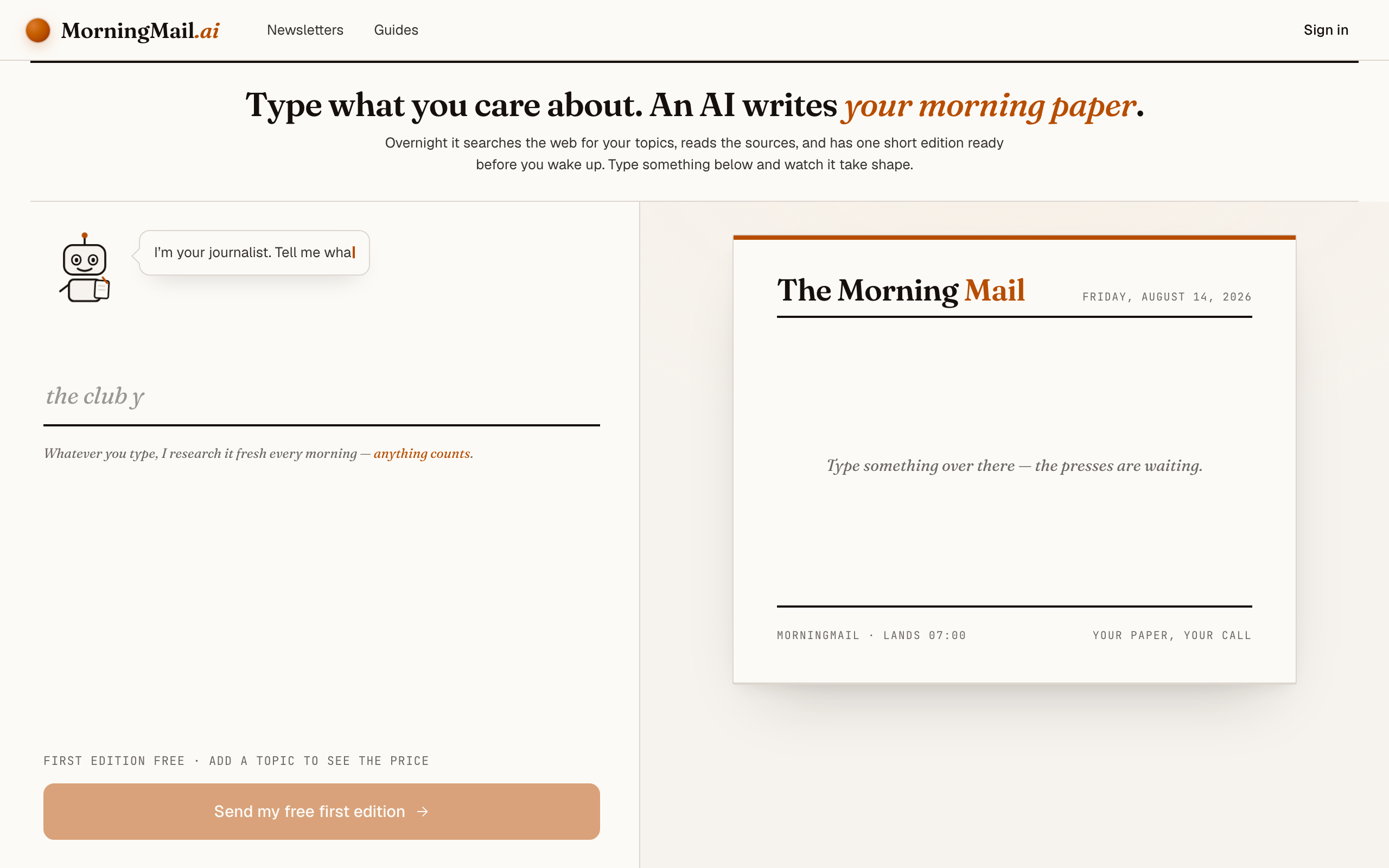
No account yet, nothing to install — the landing page IS where you compose. A friendly press robot introduces itself above one big input, and the paper you're about to fill sits waiting on the right.
Step 2 Type your topic: Legal tech
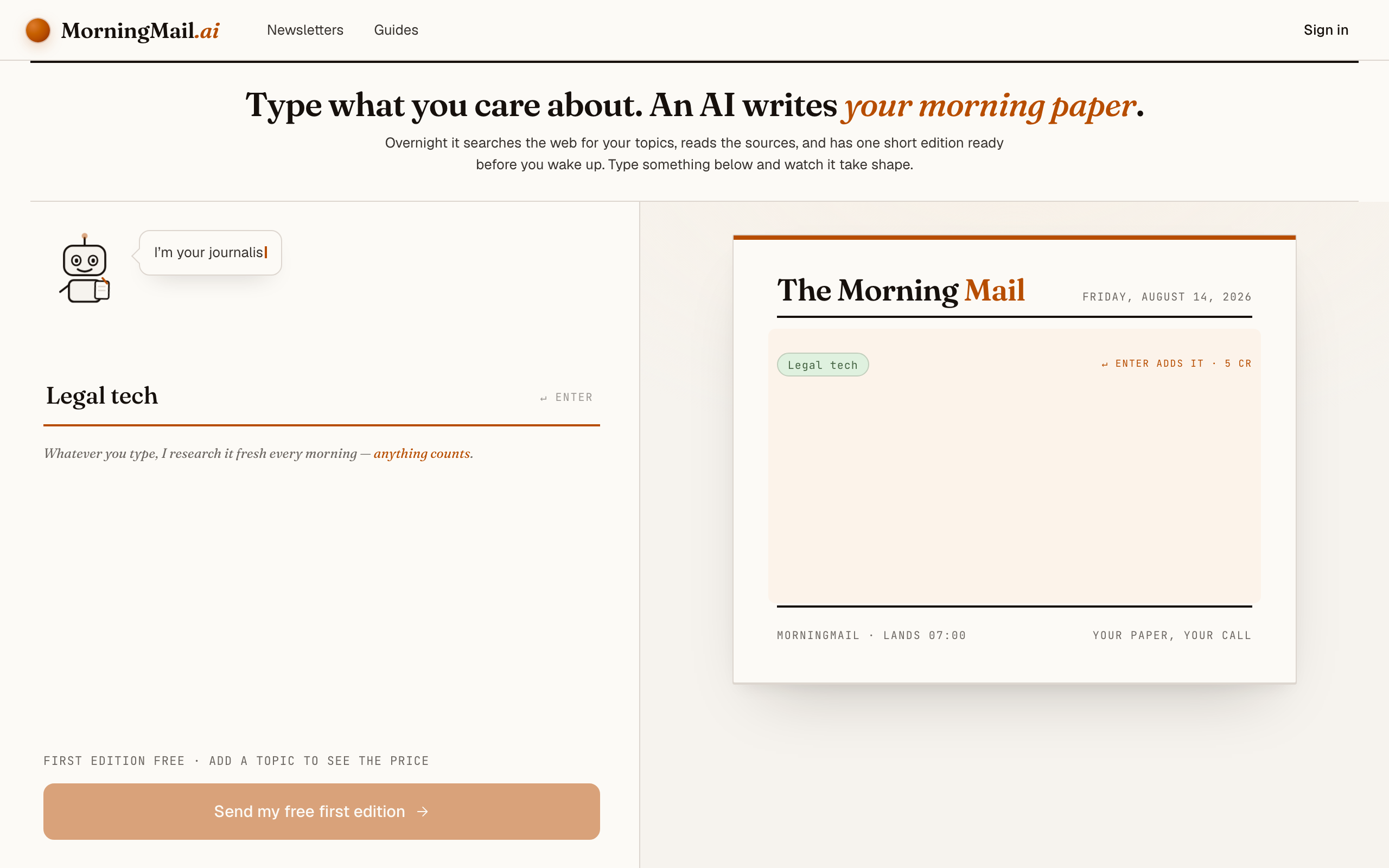
Type Legal tech into that one input. There is nothing to pick and no form to fill — as you type, a draft section forms on the paper beside you, carrying your topic in a tinted badge and the quiet prompt "↵ Enter adds it".
Step 3 Press Enter — and read what the agent was told
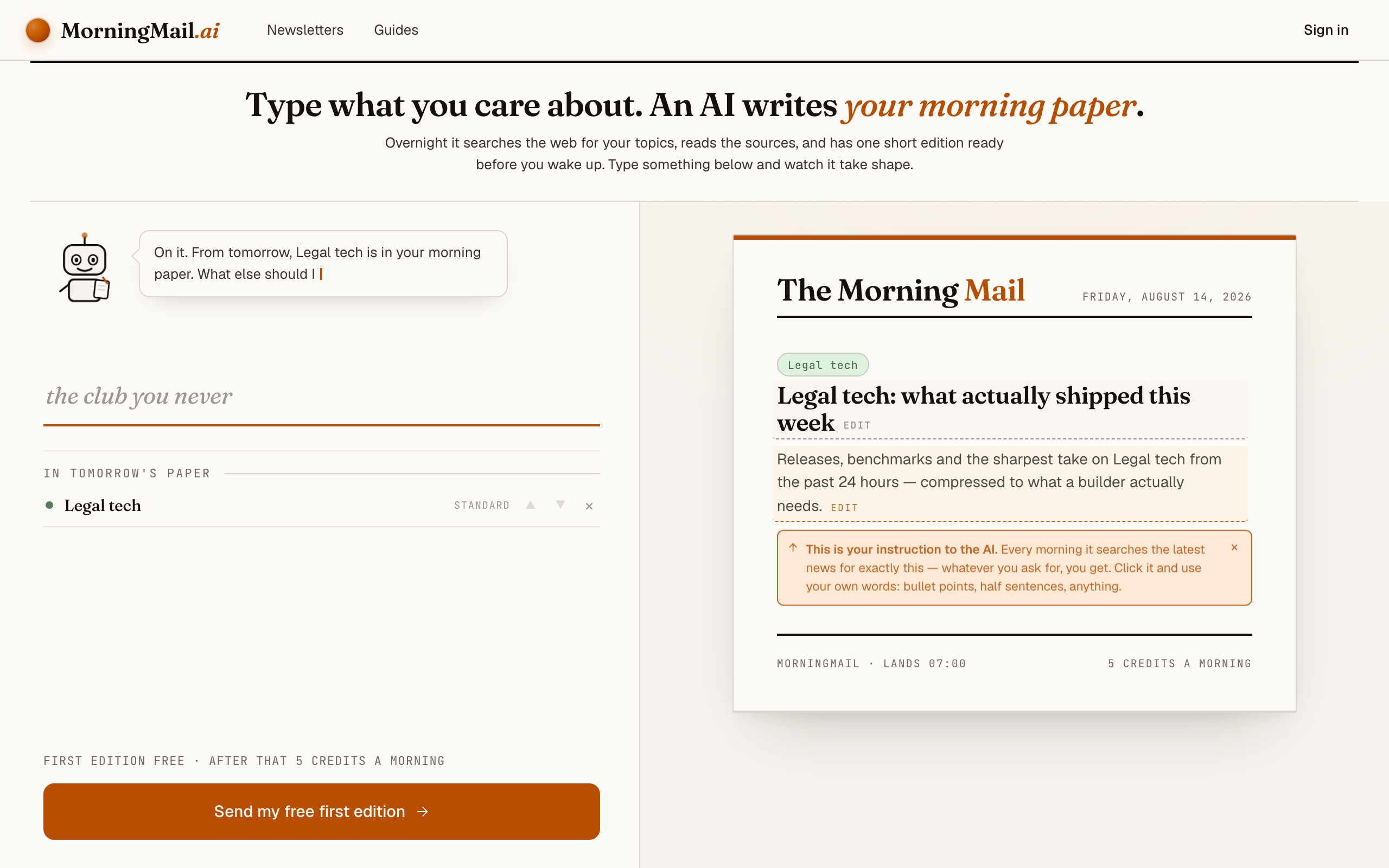
Type Legal tech into the one big input on morningmail.ai and press Enter. The section arrives on the paper with a suggested headline and an Assignment already drafted for it — the exact instruction your agent will follow, on screen before it has ever run and before you have an account.
For a lawyer that draft is nearly right already: what moved overnight, why it matters and who said it, the original source only, never an aggregator. Sharpen it with your practice — click the Assignment and write: "Prioritise court decisions and bar-association guidance on AI use in practice. I run e-discovery for a mid-size litigation firm; flag rulings on AI-generated evidence and anything touching client-confidentiality duties." And "+ name sources", one of the one-tap tweaks under the field, appends the citation demand without you typing it.
The exact prompt your section starts withReleases, benchmarks and the sharpest take on Legal tech from the past 24 hours — compressed to what a builder actually needs.
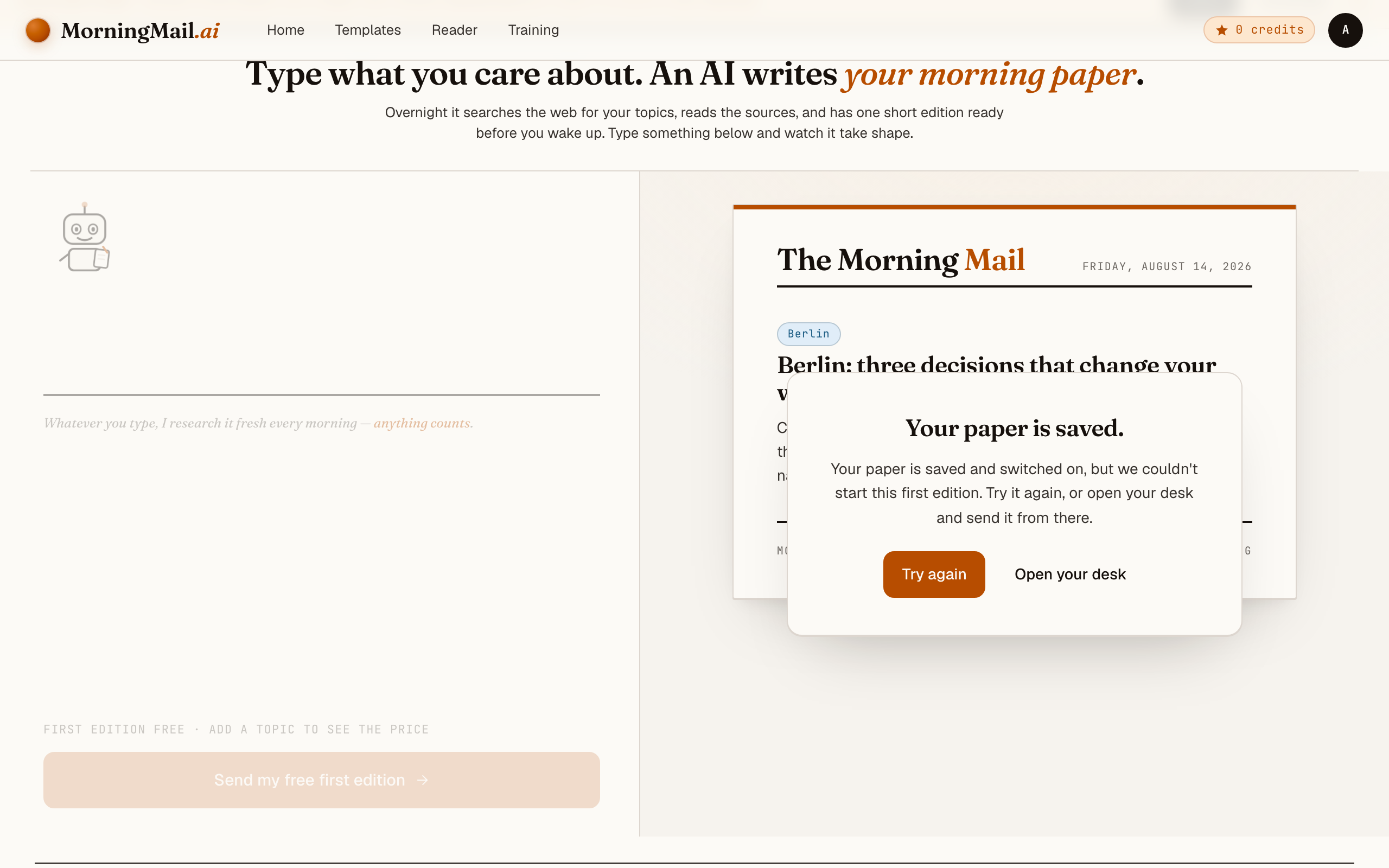
Step 4 Send your free first edition
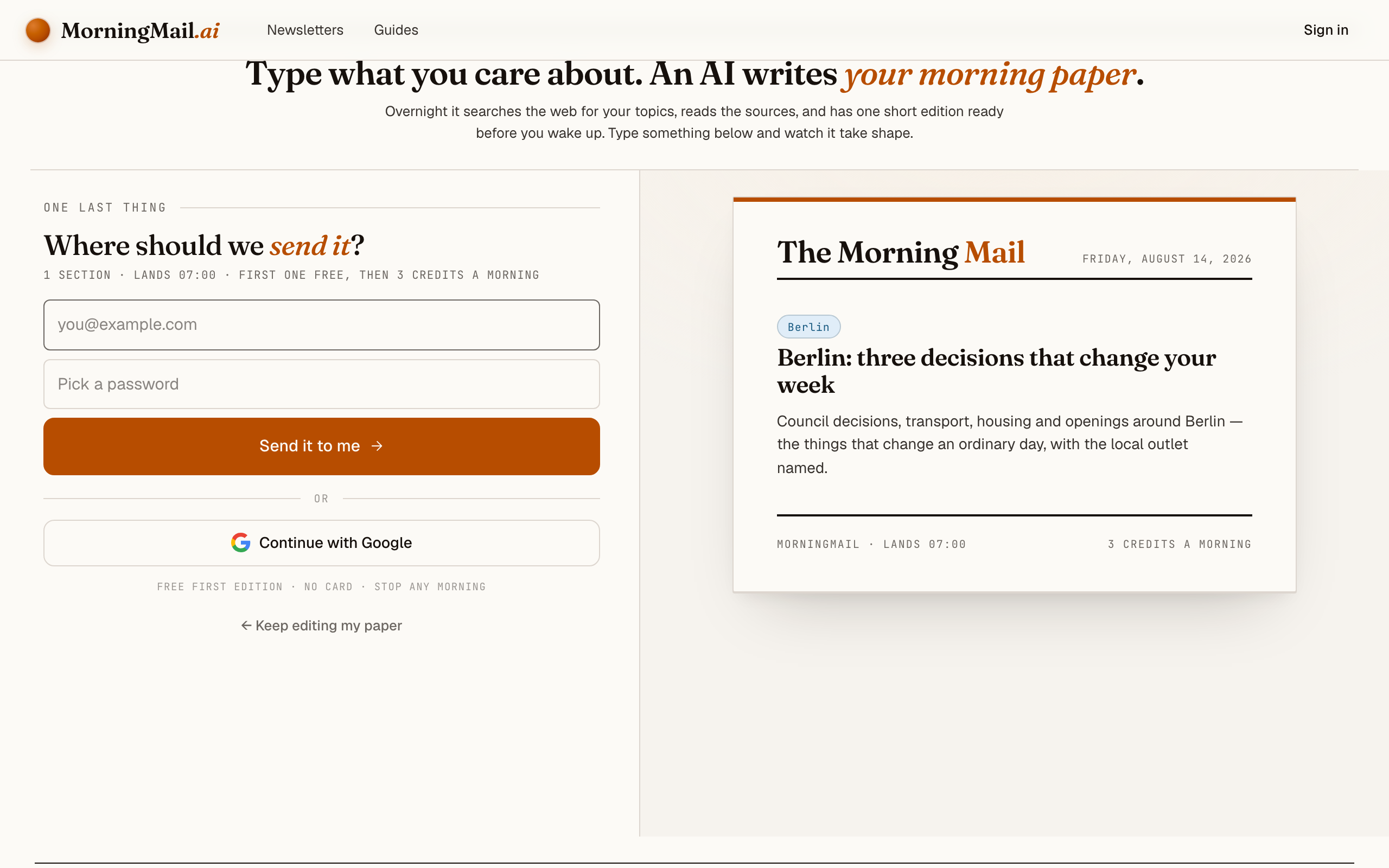
Happy with the paper? Hit "Send my free first edition". The sign-up appears right there — the paper never leaves the screen — and asks the only thing it still needs: where to send it. Email and password, or Google. No card, and the first edition is free.
Step 5 Watch it being written
Now the desk goes to work in front of you: working out what to look for, searching the web, reading the best sources, writing your section, composing a subject line, handing it to the post. A minute or two later: "It's in your inbox."
Step 6 Afterwards: the time, the days, the readers
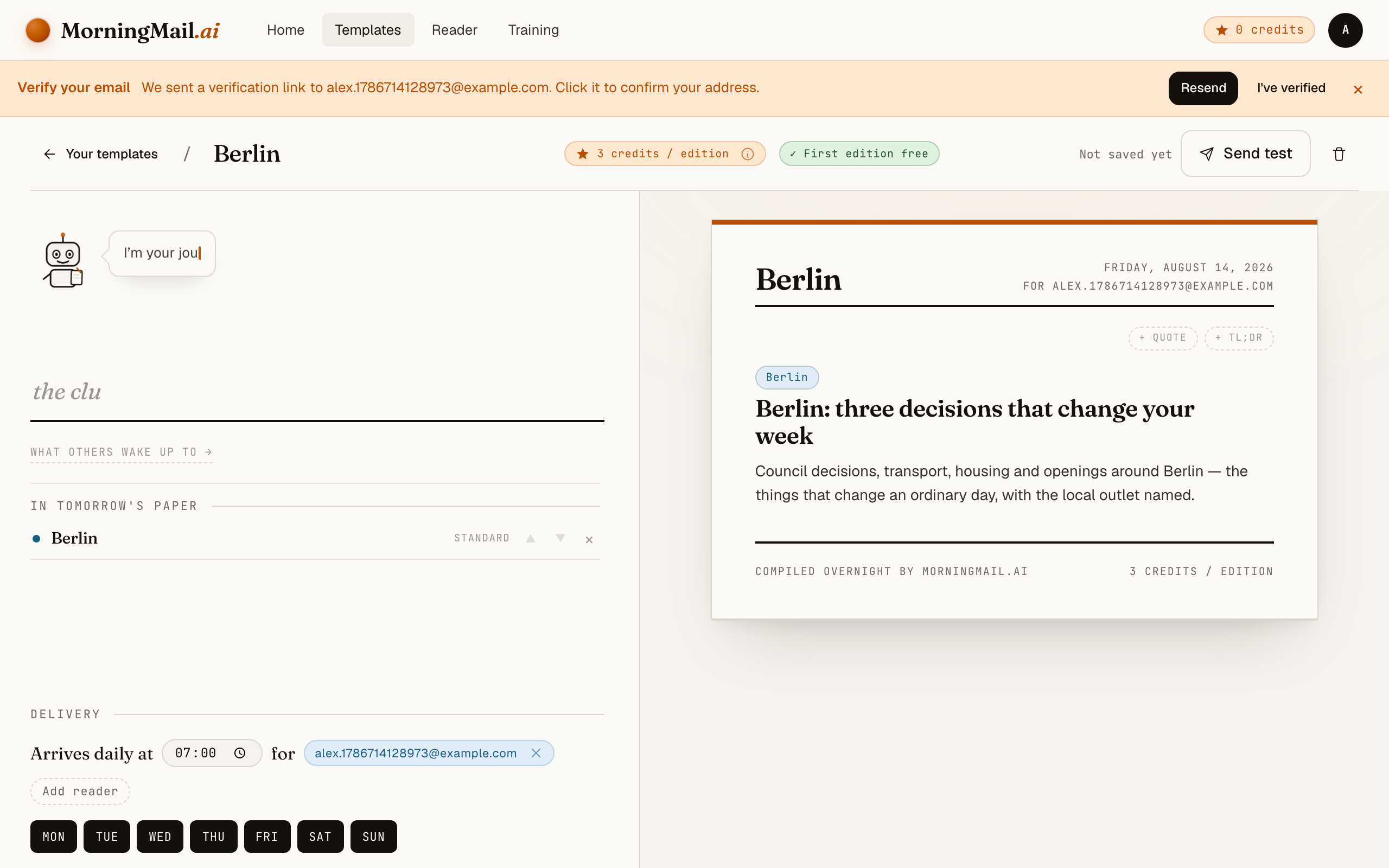
Everything else lives in the builder, once you have a paper to tune. Set the delivery time (07:00 by default) and which weekdays it runs, add readers — up to 100 — and add more topics the same way you added the first: by typing. Nothing here needs deciding on day one.
Get more out of your brief
- State your jurisdiction, or drown in American news
- Legal-tech coverage skews heavily US. One sentence — "I practise in Germany; prioritise European courts, EU regulation and German bar guidance" — reweights the entire brief. The agent researches fresh every morning, so the change applies from the very next edition.
- Separate rulings from releases
- Ask the agent to label each item: court decision, regulatory guidance, or product news. The three demand entirely different responses — one may affect a live matter, one your compliance posture, one merely your tool budget.
- Demand the docket, not the write-up
- The Assignment that lands already insists on the original source — keep that discipline when you rewrite it, and "+ name sources" puts it beyond doubt. A brief that links the sanctions order itself saves you from repeating someone else's misreading. That's the exact mistake legal tech is supposed to prevent.
- Consider twice a week instead of daily
- Legal tech moves fast, but not stock-ticker fast. You pick your weekdays freely per template — Tuesday and Friday keeps you current and respects the billable day. Switch to daily during a big matter, back afterwards.
- Add a TLDR section for partners who skim
- If you forward the brief to colleagues, add a TLDR section that compresses everything into three bullets, and set the tone to neutral. Each section has its own length and tone settings — one email, several readers.
Good sources to anchor your brief on
The agent searches the open web every morning and cites where it read things. These are the sources I'd point it at in your prompt:
- Legaltech News (Law.com) — The trade paper of record for legal technology — firm adoption, vendor moves and litigation over legal AI, reported by journalists who know the industry.
- Artificial Lawyer — Focused, opinionated coverage of AI in legal practice with a genuinely international view — one of the few outlets that treats European developments as more than a footnote.
- ABA Journal — The American Bar Association's magazine — where professional-responsibility questions around AI, billing and client confidentiality get their authoritative airing.
- LawSites (Bob Ambrogi) — A veteran journalist's running log of legal-tech launches and shutdowns — reliable early signal on which tools are real, with decades of context on which claims aren't.
- Legal Dive — Coverage aimed at in-house legal departments: legal-ops budgets, contract tooling and compliance workflows — the buyer's-side view law-firm coverage misses.
- EDRM (e-discovery community) — Standards, model protocols and case-law commentary for e-discovery — the reference body courts and vendors point to when TAR and AI review protocols are contested.
Frequently asked questions
- What does the daily brief cost?
- Nothing at first — the first edition is free, no credit card. Ongoing sends run on credits: each section costs a few, priced by the AI model tier it uses, and credits never expire. An irregular reading habit wastes nothing.
- How is this better than a Google Alert for "legal AI"?
- An alert can't tell a sanctions order from a vendor press release — it forwards both and leaves the judging to you. The agent reads the sources first, then writes you a memo: what happened, why it matters, every item linked to its primary document.
- Can I trust an AI-written summary for professional purposes?
- Treat it as triage, not authority — the way you'd treat an associate's morning summary. Every claim links to its primary source, so anything that might touch a live matter is one click from verification before you rely on it.
- Can I limit the brief to my jurisdiction or practice area?
- Yes — the Assignment is fully editable, and jurisdiction is exactly the kind of standing instruction it's made for. Write "focus on EU and German developments; I practise employment law" and every subsequent edition is filtered accordingly.
- Does it have to arrive every day?
- No. You choose the delivery time and the weekdays per template — daily, twice a week or Friday-only all work. Many lawyers pick two mornings and add the whole practice group as recipients, so everyone reads the same edition.
Your inbox, your editor
Build your own AI-written brief in two minutes. The first edition is on me — no credit card required.
Build your brief — freeI am always happy to answer questions and I'm open to feedback. Feel free to reach out at any time: marius@morningmail.ai